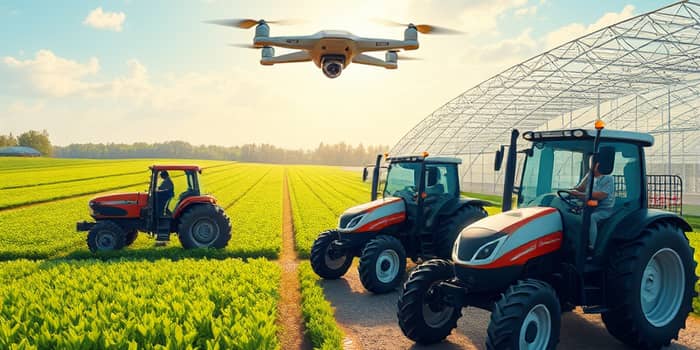
The dawn of the fourth agricultural revolution is upon us, and with it comes a transformation that promises to redefine how we cultivate, harvest, and sustain our global food supply. In an era where climate change pressures intensify and resources become scarcer, agri-tech offers a lifeline. It weaves together centuries-old farming traditions with cutting-edge digital tools, ushering in an age of unprecedented efficiency and resilience.
Embracing the Agri-Tech Revolution
Farmers are no longer tethered to guesswork. With smartphones in hand and satellite imagery at their fingertips, they can harness data-driven decisions to plan every sowing and harvest. This revolution isn’t about replacing the farmer; it’s about empowering them to become stewards of a more productive and sustainable landscape.
From smallholder plots in Southeast Asia to vast estates in North America, innovators and entrepreneurs are teaming up with agronomists and policymakers to roll out solutions that address food security, resource management, and environmental stewardship.
Key Technologies Powering Change
At the heart of the agri-tech paradigm are technologies that deliver precise insights and automate labor-intensive tasks. These breakthroughs are no longer theoretical concepts but real-world solutions deployed across millions of hectares.
- Precision Monitoring Systems: Satellite and drone imagery combined with IoT sensors yield real-time soil moisture, nutrient levels, and crop health data.
- Automated Machinery: Autonomous tractors and robots guided by GPS and onboard analytics perform planting, weeding, and harvesting without human intervention.
- AI and Big Data Analytics: Machine learning models predict weather patterns, optimize input application, and forecast yields with remarkable accuracy.
These integrated technologies reduce waste, lower costs, and enhance yields, all while minimizing environmental impact.
Market Dynamics and Growth Trajectory
The agri-tech market has ascended from a niche sector into a multi-billion dollar industry. In 2024, its valuation rested at an estimated $24.42 billion, and by 2030 projections suggest it could soar past $50 billion, fueled by a compound annual growth rate exceeding 12%.
Key drivers include a global population set to near 9.7 billion by mid-century, escalating concerns over food security, and mounting pressure to reduce agriculture’s environmental footprint. Governments worldwide have recognized these imperatives, channeling billions into R&D grants, incentives, and pilot programs.
Regional Perspectives
Agri-tech adoption varies across regions, each shaped by distinct challenges and opportunities:
In North America, high-tech farms leverage robust infrastructure and capital to pioneer large-scale deployments of robotics and AI. Meanwhile, in the Asia-Pacific, a fast-growing middle class demands higher quality produce, driving rapid uptake of precision farming and controlled environment agriculture. Latin America focuses on scalable solutions for smallholder integration, supported by public-private partnerships that foster knowledge sharing and investment.
Major Innovators and Market Leaders
Driving Sustainability and Impact
Beyond yield and profit, the real triumph of agri-tech lies in its positive environmental and social impact. By tailoring interventions to specific field conditions, farmers drastically reduce water use and chemical runoff. Crops engineered through biotechnology resist drought and pests, slashing the need for resource-intensive inputs.
- Vertical Farming Solutions that produce food using 90% less water than conventional methods.
- Blockchain Traceability ensuring consumer trust by documenting every step from seed to supermarket shelf.
- IoT Supply Chains that monitor temperature, humidity, and handling to preserve quality and minimize waste.
Overcoming Challenges and Harnessing Potential
Despite its promise, the agri-tech sector must surmount obstacles including high initial investment costs, data privacy concerns, and the need for user-friendly interfaces that serve farmers of all scales and literacy levels. Public-private collaboration and tailored financing models are essential to ensure equitable access and maximize adoption among smallholder communities.
Education and extension services must evolve alongside technology, equipping farmers with the skills to interpret data dashboards and troubleshoot automated systems. By fostering a culture of continuous learning and innovation, the industry can avoid a digital divide and ensure that no producer is left behind.
The Road Ahead: Future Trends
Looking forward, the most exciting frontier lies at the intersection of biology and robotics. Synthetic biology will unlock crops that self-adapt to stress, while nanotechnology could deliver nutrients directly to plant tissues. Swarms of micro-drones might one day pollinate orchards or apply targeted treatments at the individual leaf level.
Meanwhile, integrated platforms that unify farm management, supply chain logistics, and market intelligence will empower stakeholders from seed companies to retailers. Collaborative innovation ecosystems—linking startups, research institutions, and traditional agribusiness—will accelerate breakthroughs and scale them rapidly across diverse geographies.
In charting this path, we honor one of humanity’s oldest endeavors—growing food—while embracing the tools of tomorrow. The agri-tech narrative is more than a tale of machines and data; it is a testament to human ingenuity, resilience, and our capacity to steward the Earth for generations to come.
References
- https://www.techtarget.com/whatis/definition/agri-tech
- https://www.precisionfarmingdealer.com/articles/6551-global-agritech-market-expected-to-grow-to-4898-billion-by-2030
- https://en.wikipedia.org/wiki/Agricultural_technology
- https://www.arizton.com/market-reports/agritech-market
- https://www.leher.ag/blog/agritech-transforming-indian-agriculture
- https://www.mordorintelligence.com/industry-reports/global-agritech-market
- https://seedblink.com/blog/2022-05-13-agritech-vertical-overview
- https://www.startus-insights.com/innovators-guide/agritech-report/
- https://www.doktar.com/en/blog/digital-agtech/what-is-agricultural-technology/
- https://www.statista.com/statistics/1238525/worldwide-agriculture-technology-as-a-service-market/
- https://www.xcubelabs.com/blog/exploring-agri-tech-the-technologies-driving-global-agriculture/
- https://www.cognitivemarketresearch.com/agritech-market-report
- https://climate.ai/blog/agritech-future-of-farming/
- https://gdc.einnews.com/amp/pr_news/884774924/agritech-industry-analysis-market-competition-and-future-opportunities
- https://www.pivotint.com/blog/the-rise-of-agritech/