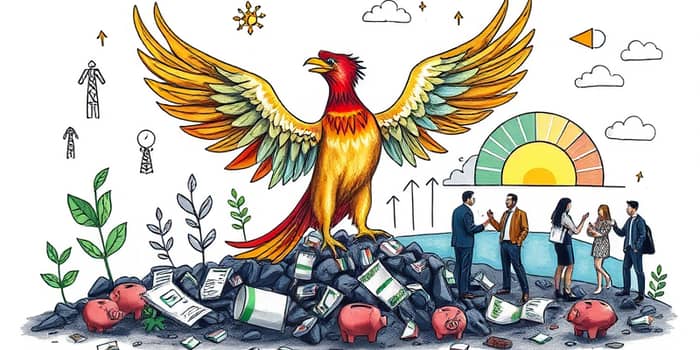
When your balance sheets read more red than green, it can feel like the end of the road. Yet, even in the darkest financial moments, a clear, structured approach can ignite a transformation that leads from “beyond broke” to lasting stability and growth. This guide brings together economic insights, strategic frameworks, and human-focused tactics to help you craft a resilient, forward-looking financial blueprint.
Understanding the Landscape
We begin by facing the facts. Interest rates, though eased twice recently by the Federal Reserve, remain historically elevated. Thirty-year fixed mortgage rates linger around 6%, and 10-year Treasury yields hover near 4%. At the same time, recession odds stand at about 40%, unemployment is rising, and consumer demand shows signs of cooling.
For businesses carrying debt—imagine a company with $1 million outstanding—the interest burden increases by $20,000 to $30,000 annually compared to a lower-rate era. In this environment, disciplined cost management and measurable returns on investment aren’t optional; they are survival imperatives. Recognizing this economic uncertainty equips you to craft strategies that are both aggressive in seizing opportunity and cautious in hedging risk.
Building a Strategic Framework
A robust turnaround begins with clear budget allocation and rigorous cost discipline. By aligning every dollar spent with strategic priorities, you create a financial foundation that supports both resilience and growth.
- Technology Investment: Allocate 3–7% of revenue to proven tech with real productivity gains.
- Cybersecurity: Dedicate 5–8% of IT budget—quantum security alone should claim over 5% of that spend.
- Risk Management: Set aside 2–4% of revenue for insurance, governance, and compliance safeguards.
- Compensation & Talent: Reserve 3–7% of payroll to close pay equity gaps and retain critical skills.
Next, apply zero-based budgeting: question every expense as if it were your own capital at stake. Optimize working capital by reducing inventory by 15–20% through improved forecasting, and plan for a 15–30% uptick in carrying costs driven by tariffs and supply chain resilience measures. Where debt is maturing or variable, refinance now or deploy free cash to retire high-rate obligations.
Optimizing Cash Flow and Liquidity
Liquidity is the lifeblood of any turnaround. Building reserves equivalent to six to twelve months of operating expenses provides a critical cushion against unexpected shocks. Implement 12-month rolling forecasts updated monthly and maintain three to five scenarios—from a base case to a 25% revenue decline scenario—with clear trigger points for action.
- Cash Reserve Targets: Aim for 6–12 months of coverage.
- Scenario Planning: Develop, model, and review quarterly at minimum.
- Credit Management: Proactively assess customer credit risk and consider trade credit insurance.
Speed up decision cycles: shift from months to weeks by instituting weekly cash flow reviews and monthly deep dives. This agile cadence ensures you can pivot quickly when markets or customers change.
Driving Growth with Selectivity
Growth is essential but must be pursued selectively. Focus on initiatives where you hold a clear competitive advantage and which promise payback within 12–18 months. Prioritize recurring revenue models that enhance company valuation and explore strategic acquisitions at favorable valuations.
- Investment Criteria: Only back projects with clear differentiation and fast payback.
- Capital Planning: Build 24–36-month plans, stress-tested for elevated rates through 2027.
- Banking Relationships: Strengthen ties now—don’t wait until you need capital.
Harnessing AI and Technology
2026 marks the shift from AI pilots to full-scale deployments. Organizations embracing AI wholeheartedly can achieve 20–30% productivity gains, driving revenue growth, cost savings, and faster decision-making. Key applications include marketing optimization, customer service automation, analytics and forecasting, inventory management, and acquisition target analysis.
To secure material business impact, define clear metrics for AI ROI early, track performance continuously, and scale the most promising use cases enterprise-wide.
Nurturing Your Workforce
Your people are both your largest expense and most valuable asset. A thoughtful workforce strategy balances strategic reductions with targeted investments in high-impact roles.
- Workforce Evolution: Offer generous severance in declining functions while hiring specialized AI, cybersecurity, and data science talent.
- Compensation Strategy: Conduct pay equity audits, establish transparent pay bands, and monitor cost-per-hire metrics.
- Upskilling Programs: Invest in AI literacy, hybrid leadership, technical platforms, and cybersecurity awareness.
By treating talent as an ROI driver rather than a cost center, you foster a culture of continuous improvement and innovation.
Strengthening Operational Resilience
Supply chains remain under pressure. Implement visibility tools for real-time tracking, budget for increased carrying costs related to tariffs, and update supply chain scenario models at least quarterly. Elevated carrying costs of 15–30% should be built into your financial plans, and credit facilities must support working capital needs.
A robust governance and compliance framework—encompassing cybersecurity, insurance, backup systems, and clear decision rights—builds trust with stakeholders. Transparent communication accelerates buy-in and sustains confidence.
Measuring Success and Future-Proofing
Reliable metrics are the compass guiding your turnaround. Track technology ROI meticulously—if you can’t measure investment outcomes, you risk burning cash disguised as innovation. Monitor key ratios such as debt-to-equity, operating cash flow coverage, and revenue per employee.
Looking beyond the immediate crisis, begin envisioning where you want to be in 5–10 years. Develop technology-led value propositions that differentiate you in the market, and stay ahead of evolving investor expectations. For financially healthy companies, this is the opportunity to expand while competitors hesitate.
Turning around a dire financial situation demands a holistic approach: a deep understanding of external pressures, a rigorous internal framework, and a people-first mindset. By combining disciplined budgeting, agile liquidity management, selective growth, transformative technology adoption, and a resilient workforce strategy, you can rise from beyond broke to well beyond expectations. The path will not be easy, but with clear plans, measurable goals, and unwavering commitment, you will reclaim stability, unlock growth, and build a future defined by strength and adaptability.
References
- https://theceosrighthand.co/business-trends-2026/
- https://www.broadridge.com/next/articles/2026-predictions-article
- https://www.deloitte.com/us/en/insights/topics/leadership/finance-trends-leadership.html
- https://www.library.hbs.edu/working-knowledge/eight-trends-for-2026-pricing-passion-and-the-risks-ahead
- https://www.financialexecutives.org/FEI-Daily/January-2026/financial-executives-priorities-report-2026.aspx
- https://www.slalom.com/us/en/insights/financial-services-outlook-2026
- https://insightglobal.com/blog/2026-financial-services-trends/
- https://www.altusgroup.com/podcasts/cre-exchange-data-and-policy-shaping-the-early-2026-cre-market/
- https://www.statista.com/business/solutions/industry-finance