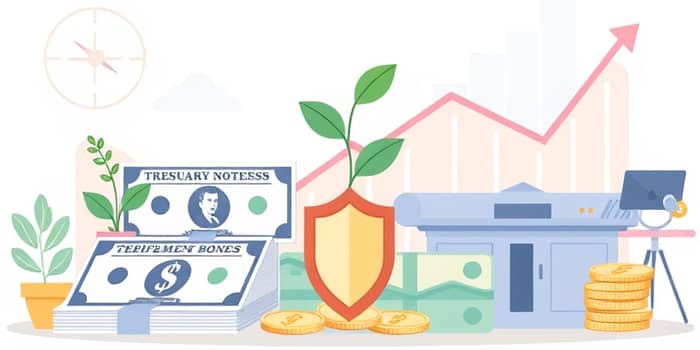
In today's volatile financial world, bonds offer a sanctuary of reliable income and security. This guide will transform how you view fixed income investments.
They provide a foundation for building wealth through steady returns. Understanding bonds is key to navigating market uncertainties.
With yields at historic highs, now is an opportune moment to invest. Bonds can diversify your portfolio and reduce overall risk effectively.
Understanding Bond Fundamentals and Mechanics
Bonds are debt securities where you lend money to issuers like governments or corporations. In return, you receive periodic interest payments and principal repayment at maturity.
Pricing varies from discount to premium based on market conditions. Interest is earned through coupons or price appreciation over time.
Key risks must be managed for successful investing. These include credit risk, interest rate risk, and inflation risk.
- Credit Risk: The chance of issuer default affecting returns.
- Interest Rate Risk: Bond prices fall when interest rates rise.
- Market/Liquidity Risk: Difficulty in selling bonds quickly.
- Inflation Risk: Eroding purchasing power of future payments.
Credit ratings help assess safety levels. Investment-grade bonds offer lower risk profiles for conservative investors.
High-yield bonds provide higher returns but come with increased volatility. Maturity impacts bond behavior significantly.
Short-term bonds are more stable against rate changes. Long-term bonds offer greater income potential for growth seekers.
Exploring Major Bond Types for Your Portfolio
Diversifying across bond types enhances returns and mitigates risk. Here are the core categories to consider.
U.S. Treasuries are backed by the government, ensuring the lowest credit risk. They are ideal for stability and income in any portfolio.
- T-Bills: Short-term instruments sold at a discount, no coupons.
- T-Notes: Medium-term with semi-annual coupon payments.
- T-Bonds: Long-term options for steady, reliable income.
- TIPS: Inflation-protected securities safeguarding against rising prices.
- FRNs: Floating rate notes that adjust with market rates.
Municipal bonds, or munis, are issued by local governments. They often provide tax-exempt income, making them efficient for investors.
With low default rates, munis are a smart choice for diversification. They fund public projects while offering steady returns.
Corporate bonds range from investment-grade to high-yield categories. They offer higher yields than Treasuries but involve more risk.
- Investment-Grade: Steady income with moderate default risk.
- High-Yield: Maximize income but with higher chance of default.
Agency and structured bonds include government-sponsored entities. They provide intermediate stability and income for balanced portfolios.
Higher-yield alternatives like preferred securities boost returns. Emerging market debt offers attractive growth opportunities in global markets.
Current Market Context: The 2025-2026 Outlook
The economic landscape is shifting with moderating growth and persistent inflation. Bonds are poised to perform well in this environment.
Growth is expected to slow, with U.S. GDP forecasted at 1.0%. However, no recession is anticipated due to resilient labor markets.
Inflation remains around 3.0%, driven by tariffs and housing costs. This supports bond investments as a hedge against uncertainty.
Interest rates are forecasted to decline with Fed cuts in 2025 and 2026. This could lead to price appreciation for existing bonds.
- Fed Funds Rate: Projected to drop to 3.75-4.00% by end-2025.
- 10-Year Treasury Yield: Expected to be 4.25%, offering historic high yields.
Yields are at levels not seen in decades, making bonds compelling. They provide resilience during equity market downturns and volatility.
Performance across bond sectors is positive, with higher-yield options showing strength. Economic drivers include easing cycles and fiscal policies.
For 2026, solid fixed income returns are anticipated from rate cuts. High yields are likely to persist, benefiting income-focused investors.
Strategic Insights for Income, Stability, and Growth
To leverage bonds effectively, align them with your financial goals. This section provides practical strategies for success.
For income, focus on high-yield sectors like corporates and emerging market debt. Starting yields drive total returns significantly in current markets.
For stability, core holdings such as Treasuries are essential. Short-duration bonds can mitigate rate risk during volatile periods.
For growth, seek total return from yield plus price gains. Bonds that benefit from falling interest rates offer appreciation potential.
Bonds play a crucial role in portfolio diversification by counterbalancing stocks. They provide steady cash flow during market turbulence and downturns.
Consider current factors like rate volatility and credit spreads. Prefer quality bonds in a slowing economy to safeguard your investments effectively.
ETFs can offer easy diversification across bond types. They are a practical tool for modern investors seeking simplicity and efficiency.
Practical Steps to Implement Your Bond Strategy
Start by assessing your risk tolerance and investment horizon. This will guide your bond selection and allocation decisions.
Diversify across maturities and credit qualities for optimal results. A mix of bonds can enhance returns while managing risk.
- Review your current portfolio for adequate bond exposure.
- Allocate based on specific goals: income, stability, or growth.
- Monitor economic indicators and adjust strategies as needed.
- Use professional advice for complex or high-stakes investments.
- Consider laddering strategies to balance income and liquidity.
With the 2025-2026 outlook, acting now can capitalize on opportunities. Bonds offer a unique combination of safety and potential for prosperity.
Embrace bonds as a dynamic component of your financial plan. They are not just for preservation but for achieving long-term wealth goals.
Regularly rebalance your portfolio to maintain desired risk levels. This ensures your investments stay aligned with changing market conditions.
Stay informed about global economic trends and policy changes. Knowledge empowers you to make informed investment decisions confidently.
Bonds can transform your financial future with disciplined approaches. Start today to harness their power for income, stability, and growth.
References
- https://www.schwab.com/learn/story/what-are-bonds-understanding-bond-types-and-how-they-work
- https://www.nuveen.com/en-us/insights/fixed-income/bond-markets-lean-into-income-as-growth-moderates
- https://www.merrilledge.com/article/understanding-bonds-and-their-risks
- https://www.blackrock.com/us/financial-professionals/insights/seek-stability-with-bond-etfs
- https://www.rbcgam.com/en/ca/learn-plan/investment-strategies/types-of-bonds-and-how-do-they-work/detail
- https://www.fidelity.com/learning-center/trading-investing/bond-market-outlook
- https://investor.vanguard.com/investor-resources-education/understanding-investment-types/us-treasury-bonds
- https://www.schwab.com/learn/story/fixed-income-outlook
- https://www.home.saxo/learn/guides/bonds/guide-to-government-bonds-and-how-they-work
- https://www.aristotlefunds.com/post/the-year-in-fixed-income-told-in-10-charts
- https://treasurydirect.gov/marketable-securities/
- https://advisors.vanguard.com/insights/article/series/active-fixed-income-perspectives
- https://treasurydirect.gov/marketable-securities/treasury-bonds/
- https://www.jpmorgan.com/insights/markets/top-market-takeaways/tmt-navigating-rate-risks-how-bonds-are-better-positioned-in-2025
- https://treasurydirect.gov/savings-bonds/comparing-ee-and-i-bonds/