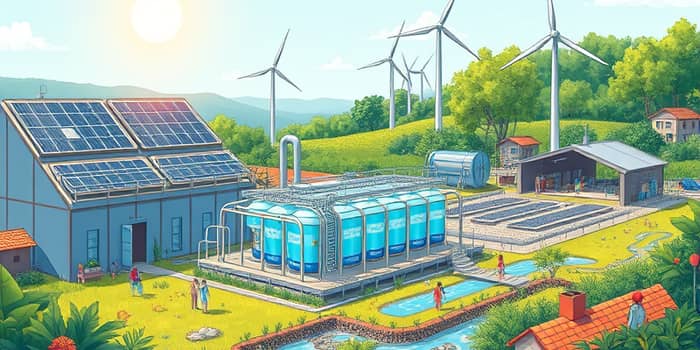
Ensuring universal access to clean water remains one of the greatest challenges of our time. Despite being recognized as a fundamental human right, safe drinking water eludes millions, especially in regions facing pollution, drought, and aging infrastructure. Fortunately, a wave of technological advancements and strategic investments offers new hope. By championing innovative purification methods, smart distribution networks, and integrated wastewater solutions, society can bridge the gap between scarcity and abundance.
Global Water Crisis Context
Around the globe, 2.2 billion people lack reliable access to safely managed drinking water sources, often resorting to contaminated supplies that threaten health and livelihoods. Rural communities are particularly vulnerable, as they contend with limited infrastructure and resource constraints.
Urban centers also struggle: leaky pipes, inefficient treatment plants, and climate-induced stress have left municipalities scrambling to maintain existing water quality. In over 40% of countries, Environmental Performance Index scores fall below 50/100, underscoring the urgent need for systemic improvements.
Contamination, scarcity, and infrastructure gaps converge to deepen inequality and economic strain, emphasizing that water security is inseparable from social and environmental justice.
Purification Technologies Driving Change
Modern purification is no longer a one-size-fits-all endeavor. A portfolio of technologies allows stakeholders to tailor solutions based on resource availability and contaminant profiles.
Filtration methods, including reverse osmosis, ultrafiltration, and microfiltration, reliably remove pathogens and dissolved solids. Membrane processes have become more durable and cost-effective, with modular designs suited for both municipal plants and remote villages.
Bio-sand filters exploit layers of sand and gravel, augmented by naturally occurring biofilms that degrade organic material. These systems, often managed locally, require minimal energy and deliver low maintenance rural water treatment.
GEM® nanobubble flotation systems provide an advanced twist on traditional dissolved air flotation (DAF). By generating ultra-fine bubbles, they capture fats, oils, and greases (FOG) along with suspended solids, enabling installations in over 1,000 sewage and industrial facilities across 18+ countries.
Desalination continues to evolve with solar-driven evaporation units and membrane distillation that harnesses low-grade heat. Such approaches cut energy consumption by up to 40%, making seawater conversion feasible for arid coastal communities.
Distribution and Infrastructure Innovations
Even the cleanest water must reach consumers through reliable networks. Smart infrastructure embeds sensors and actuators into pipelines, conducting real-time monitoring of pressure, flow, and quality. These systems detect leaks and contamination events almost instantaneously, reducing non-revenue water losses by an estimated 15–30%.
- Decentralized networks such as community rainwater harvesting reduce dependence on centralized grids.
- AI-driven precision irrigation reclaims wastewater for agriculture, optimizing crop yields while conserving freshwater.
- IoT platforms continuously log water parameters, informing responsive maintenance and ensuring compliance.
By blending connectivity with advanced analytics, municipalities can extend service to underserved neighborhoods without massive capital expenditures.
Wastewater Treatment and Resource Recovery
Once considered waste, treated wastewater now represents a valuable resource. Comprehensive treatment trains combine primary, secondary, and tertiary processes to maximize purification and material reuse.
Primary treatment utilizes screens and grit removal, followed by the GEM® System, which enhances FOG and suspended solids separation. Secondary stages often employ UASB or EGSB anaerobic digesters and moving bed biofilm reactors (MBBRs) to degrade organic pollutants while generating biogas.
Tertiary polishing with nanofiltration, ultrafiltration, and reverse osmosis membranes removes trace contaminants, producing water suitable for industrial reuse or indirect potable applications. Advanced specialty ion exchange resins target persistent micropollutants like PFAS, converting them into manageable waste streams or even recoverable commodities.
Bioaugmentation plays a pivotal role in accelerating biological processes. Proprietary blends—such as BCP35™, BIOBOOSTER SR™, and BCP655™—introduce tailored microbial consortia that stabilize lagoons, combat foaming, and enhance ammonia removal. Facilities adopting these products have documented 20–80% reductions in chemical demand and sludge moisture content lowered to 8–12%, significantly reducing disposal costs.
Industry-Specific Solutions
Sectors such as semiconductors, chemicals, and energy have exacting water quality requirements and produce complex effluents. Ion exchange systems employing customizable resins remove heavy metals and PFAS to parts-per-trillion levels, safeguarding process integrity and environmental compliance.
Biochar-based filters offer a sustainable method for treating high-strength industrial streams, adsorbing organic compounds and facilitating the recovery of critical minerals. In the energy sector, off-grid solar and wind installations power small-scale treatment units, demonstrating integrated renewable energy solutions that decouple operations from volatile grid supplies.
Key Statistics at a Glance
Investment Rationale and Challenges
Investment in clean water infrastructure offers compelling returns: reduced operational expenditure, lower chemical usage, and decreased greenhouse gas emissions. Over 1,000 installations testify to the scalability of modern systems, while emerging technologies promise further cost declines.
Nevertheless, barriers persist. Significant operational cost reductions are achieved through process optimization and energy integration, but high upfront expenses and energy-intensive baseline methods can deter adoption in low-income regions.
Equity-driven funding models and incentives are essential to ensure marginalized communities are not left behind. Blended finance—combining public grants, impact investments, and carbon credits—can de-risk projects and attract private capital where traditional loans fall short.
Future Directions and Emerging Trends
By 2026, the sector aims to align with Sustainable Development Goal 6, securing universal access to clean water and sanitation. AI-driven predictive maintenance, causal models for desalination efficiency, and digital twins of treatment plants will elevate performance benchmarks.
Research in advanced materials—graphene membranes, tailored carbon composites—promises higher flux rates and fouling resistance. Simultaneously, bioaugmentation strategies are evolving to include synthetic biology approaches, creating microbial strains that degrade emerging contaminants more rapidly.
Calls to Action
Achieving a sustainable water future requires coordinated efforts among governments, NGOs, academia, and the private sector. Prioritizing research in materials science, expanding decentralized infrastructure, and fostering public-private partnerships for infrastructure will accelerate progress.
Community engagement is equally important. Empowering local stakeholders through training and capacity building ensures that technologies are maintained and optimized over time. By embracing an ecosystem approach, we can transform water treatment from a cost center into a driver of economic resilience and environmental stewardship.
Together, we can forge a path toward water equity, where every drop is cherished, every system is efficient, and every community thrives.
References
- https://scaleuplab.gatech.edu/advancements-in-clean-water-technologies-affordable-and-sustainable-solutions/
- https://www.techconnectworld.com/World2026/sym/Industrial_Water_Sustainability.html
- https://cwt-global.com/about-clean-water-technology/
- https://www.cortecvci.com/press-release-unlocking-clean-water-goals-for-2026-with-bioaugmentation/
- https://www.startus-insights.com/innovators-guide/water-treatment-industry-report/
- https://wcponline.com/2026/01/02/2026-water-treatment-industry-predictions/
- https://cleancurrents.org