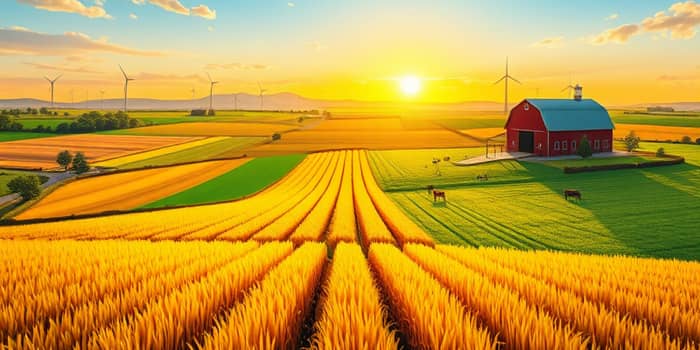
Farmland sits at the heart of human civilization, providing the food, fiber, and resources that sustain communities and economies worldwide. In an era of rapid change—marked by climate challenges, evolving consumer demands, and technological breakthroughs—it is more important than ever to understand how farmland values, farm incomes, and sustainable practices intertwine. By exploring the latest economic projections, global trends, and conservation methods, we can appreciate how agriculture continues to innovate and adapt.
The following article delves into key performance indicators for U.S. agriculture, examines worldwide land use and production patterns, and highlights proven strategies for sustaining and enhancing our precious soils. Whether you are a farmer, policymaker, or concerned global citizen, discovering the dynamic landscape of modern agriculture can ignite hope and inspire concrete action.
Economic Performance and Future Projections
U.S. net farm income (NFI) is forecast to reach an impressive record high of $180.1 billion in 2025, marking a 28.5 percent increase over the previous year. This projection places 2025 among the top three highest NFIs since 1960. The surge reflects both anticipated price support measures and a decline in key input costs, driven by lower pesticide and feed expenses.
Gross cash income is projected to rise 4.6 percent, totaling $609.4 billion in 2025. Though still below the 2022 peak of $652.3 billion, this growth illustrates a resilient sector adapting to shifting global markets and policy landscapes. On the expense side, total production costs are expected to fall by $6.1 billion, thanks in part to a 10.8 percent drop in feed expenses and a 9.9 percent reduction in fertilizer and pesticide costs.
Farm debt is also on the rise. Total real farm sector debt is projected to climb 2.8 percent to $561.8 billion, with real estate debt—a dominating factor—reaching a record $374.2 billion. Meanwhile, the real value of farm assets is set to grow 3.4 percent to $4.4 trillion, supporting overall farm equity of $3.8 trillion.
Global Land and Production Trends
On the world stage, agricultural land is under pressure. Since 1961, arable land has shrunk by nearly one third due to deforestation, erosion, and the advancing threat of desertification. Despite this, global agricultural and fish production is projected to grow by 14 percent over the next decade, fueled by productivity gains and smarter land management.
The United States and India dominate arable land, each boasting over 150 million hectares allocated to crops. India dedicates more than half its land area to cultivation, while U.S. farmland represents almost seventeen percent of its total land mass. Yet the challenge remains: balancing food security for a growing population against conservation of natural ecosystems.
- Global arable land in 2019: 1.38 billion hectares
- Organic farmland reached 98.9 million hectares in 2023
- 4.3 million organic producers worldwide
- Land degradation threatens 1.7 billion people
Organic agriculture is on the rise, now accounting for 2.1 percent of the world’s farmland. Revenue from organic products reached €136.4 billion, with exports to the EU and USA up by 7.1 percent. Key growth markets include Uruguay, China, and Spain, where farmers increasingly adopt chemical-free methods to meet consumer demand for healthier food.
Sustainable Practices for Lasting Impact
Embracing sustainable agriculture is not just an environmental imperative—it’s an economic opportunity. Implementing core practices can boost yields, reduce input costs, and future-proof operations against climate variability.
- Crop rotation and diversification: Alternating crops to restore soil nutrients and break pest cycles.
- Conservation tillage and no-till farming: Minimizing soil disturbance preserves moisture and organic matter.
- Cover cropping: Planting off-season crops protects against erosion and enriches soil fertility.
- Agroforestry and rotational grazing: Integrating trees and livestock enhances biodiversity and ecosystem services.
- Sustainable livestock farming: Rotational pastures improve soil health and reduce methane emissions.
Soil health rests on four guiding principles: minimize disturbance, maximize cover, diversify biological communities, and maintain living roots year-round. By following these tenets—through no-till methods, organic mulches, and strategic crop sequencing—farmers can build resilient soils that store more carbon, retain water, and resist erosion.
Policy and Future Outlook
Governments play a pivotal role in encouraging sustainable agriculture. In the U.S., direct payments are set to reach the second-highest level on record in 2025, helping buffer farmers against market volatility. Meanwhile, the EU’s Common Agricultural Policy (CAP) is shifting toward greener objectives, mandating nutrient loss reductions of at least 50 percent and fertilizer use cuts of 20 percent by 2030.
Research agencies emphasize that sustainable practices must protect the environment, expand the natural resource base, and improve soil fertility. Public–private partnerships and advisory services support farmers in adopting eco-schemes, climate measures, and innovation grants. The combined impact of these efforts will shape the next generation of agriculture.
Looking ahead, the path for farmland lies at the nexus of productivity, profitability, and preservation. As net farm incomes climb and land values appreciate, farmers have both the incentive and resources to invest in regenerative practices. Global food demand is expected to rise by 25 percent by 2050, underscoring the urgency to scale up efficient, sustainable methods.
By weaving together economic strength, cutting-edge research, and community-driven stewardship, agriculture can continue to feed billions while safeguarding the planet. Every seed sown with respect for nature, every policy designed with long-term resilience in mind, and every farmer empowered with knowledge represents a step toward a more abundant and sustainable future.
References
- https://agiscapital.com/state-of-the-market-report-2025/
- https://regenx.ag/blog/sustainable-agriculture-practices/
- https://www.cleanwisconsin.org/our-land/sustainable-agriculture/
- http://www.ers.usda.gov/topics/farm-economy/land-use-land-value-tenure/farmland-value
- https://www.midwestlandmanagement.com/298/9-best-practices-for-sustainable-farmland-management/
- https://worldpopulationreview.com/country-rankings/arable-land-by-country
- https://agriculture.ec.europa.eu/cap-my-country/sustainability/environmental-sustainability/sustainable-agricultural-practices-and-methods_en
- https://ourworldindata.org/global-land-for-agriculture
- https://www.farmers.gov/conservation/soil-health
- https://www.oecd.org/en/publications/2025/07/oecd-fao-agricultural-outlook-2025-2034_3eb15914.html
- https://www.nifa.usda.gov/topics/sustainable-agriculture
- https://reliefweb.int/report/world/state-food-and-agriculture-2025-addressing-land-degradation-across-landholding-scales-enaritruzh
- https://farmland.org
- https://www.worldwildlife.org/our-work/food/sustainable-agriculture/