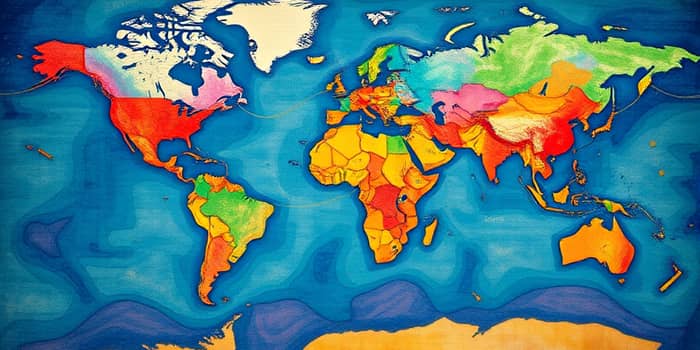
In a world defined by shifting power dynamics and unexpected crises, both individuals and organizations must cultivate resilience. By embracing informed strategies, we can transform uncertainty into opportunity and build a more stable future.
Understanding Geopolitical Risk
Geopolitical risk encompasses political, economic, military, and social threats arising from a nation’s global interactions. These risks range from armed conflicts and state tensions to trade disputes and ideological clashes. Although such events often evoke fear, they can yield positive transformations when met with proactive planning.
At its core, geopolitical risk reflects a multidimensional risk landscape and volatility driven by power shifts, regional conflicts, and evolving alliances. These factors combine to shape policy uncertainty, disrupt supply chains, and influence global markets.
Rather than viewing these challenges as insurmountable, stakeholders can interpret them as signals to refine governance frameworks, diversify partnerships, and strengthen collaborative networks.
Key Risk Hotspots for 2026
The coming year presents several critical flashpoints that demand close attention.
- US Political Revolution: Internal power struggles risk eroding institutional checks and reshaping the global order.
- US-China Competition: Geoeconomic rivalry threatens trade ties and technological cooperation across Asia-Pacific and beyond.
- Ukraine-Russia Conflict: Continued hostilities and the prospect of hybrid warfare with NATO pose the most dangerous European front.
- Middle East Tensions: Shifting alliances and narrative warfare targeting energy infrastructure sustain regional volatility.
- US-India Trade Strains: Tariffs and strategic alignments complicate two of the world’s fastest-growing economies.
Awareness of these hotspots enables stakeholders to anticipate disruptions, adjust timelines, and forge contingency plans. By mapping interconnections, businesses and policymakers can minimize exposure and leverage emerging opportunities.
Economic Impacts and Forecasts
Global growth is expected to moderate in 2026 amid geopolitical headwinds, yet resilience persists. While advanced economies contend with inflationary pressures and structural lags, emerging markets face debt constraints and fiscal tightening.
Regional growth projections illustrate divergent trajectories:
Trade volumes may decelerate as tariff front-loading fades, yet targeted policy cooperation can offset headwinds. Innovations in artificial intelligence and digital infrastructure offer potential growth catalysts, provided that adaptive risk management frameworks are in place.
Practical Strategies for Resilience
Organizations and individuals can adopt a range of measures to navigate geopolitical turbulence with confidence.
- Scenario-Driven Decision Making and Planning: Develop multiple outlooks—optimistic, baseline, and adverse—to test strategic assumptions and stress-test balance sheets.
- Diversified Portfolio with Geopolitical Insights: Spread investments across regions, sectors, and asset classes to mitigate localized shocks and currency fluctuations.
- Digital Signal Detection Capabilities: Monitor real-time news feeds, social media analytics, and satellite imagery for early warning of emerging risks.
- Strengthened Multilateral Partnerships: Collaborate with trusted allies and participate in cross-border forums to build collective resilience and shared solutions.
- Agile Supply Chain Design: Reconfigure logistics networks with alternative suppliers and nearshoring options to maintain continuity.
By embedding these approaches into core processes, decision-makers can transform unpredictability into a strategic advantage. A culture of continuous learning and rapid adaptation underpins success in an ever-evolving environment.
Building a Forward-Looking Mindset
Resilience is not merely a set of tactics but a mindset that embraces complexity and change. Leaders who cultivate a culture of curiosity and collaboration can harness the creative potential of diverse perspectives.
Key attributes of a forward-looking mindset include:
- Proactive curiosity—seeking new data and unconventional viewpoints before crises emerge.
- Cross-functional agility—breaking down silos to enable rapid reallocation of resources.
- Continuous learning—leveraging after-action reviews and real-time feedback loops.
- Emotional intelligence—fostering empathy and trust in high-pressure scenarios.
Embracing these qualities fosters a resilient culture capable of thriving amid uncertainty. It empowers teams to move from reactionary postures to anticipatory strategies, ensuring that challenges become catalysts for innovation rather than sources of disruption.
A Call to Action
The geopolitical landscape of 2026 may appear daunting, but human ingenuity and collaboration have always prevailed when guided by vision and preparation. Each stakeholder—from multinational corporations to local entrepreneurs—holds the power to shape outcomes through mindful strategy and collective engagement.
Start today by auditing current risk exposures, convening cross-disciplinary teams to craft future scenarios, and investing in the digital tools that illuminate hidden threats. As you refine your approach, remember that adaptability and foresight are the hallmarks of true resilience.
In the face of global uncertainty, let us choose to build bridges, strengthen alliances, and create a legacy of stability and prosperity. Together, we can navigate the tides of change and steer toward a horizon defined by shared growth and enduring peace.
References
- https://geopoliticalfutures.com/risk/
- https://internationalbanker.com/finance/three-key-factors-influencing-the-global-economy-in-2026/
- https://www.wellington.com/en/insights/geopolitics-in-2026-risks-and-opportunities-were-watching
- https://www.deloitte.com/us/en/insights/topics/economy/global-economic-outlook-2026.html
- https://www.eurasiagroup.net/issues/top-risks-2026
- https://www.ey.com/en_us/insights/strategy/global-economic-outlook
- https://www.bankingsupervision.europa.eu/framework/priorities/html/geopolitical-risk.en.html
- https://unctad.org/news/global-growth-holds-investment-and-uncertainty-weigh-outlook
- https://www.weforum.org/publications/global-risks-report-2026/digest/
- https://www.morganstanley.com/insights/articles/global-economic-outlook-2026
- https://www.zerofox.com/blog/geopolitical-forecast-2026/
- https://www.oxfordeconomics.com/resource/three-key-trends-to-watch-in-the-global-economy-in-2026/
- https://www.weforum.org/stories/2026/01/4-reasons-global-economy-resilient-imf-2026-outlook/
- https://www.youtube.com/watch?v=dqVfnC_muaI