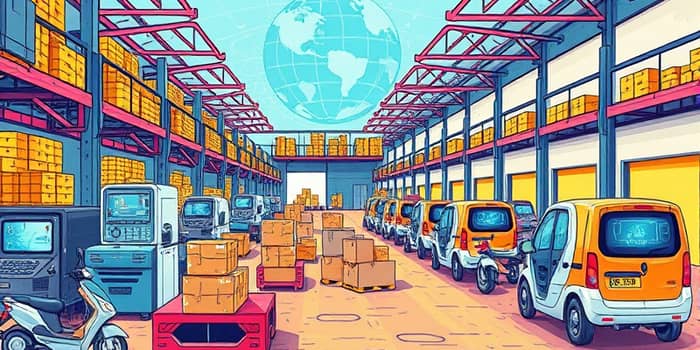
In today’s hyperconnected world, the seamless delivery of goods underpins consumer trust and brand loyalty. Logistics and warehousing have evolved from cost centers into strategic assets, powering the very essence of online retail.
Riding the Wave of Exponential Growth
Global e-commerce sales have surged past $6.42 trillion, and logistics providers are scaling to match. Forecasts predict a jump from USD 581.95 billion in 2025 to USD 3,646.79 billion by 2035, achieving astounding rates of expansion.
Amid this boom, the domestic segment alone reached USD 277.7 billion in 2024. Markets in APAC account for over 57% of the incremental opportunity, while North America continues to innovate in omnichannel fulfillment and micro-centers.
Key Drivers Fueling the Revolution
Several forces converge to accelerate logistics growth:
- surging online retail volumes, driven by smartphone and internet penetration.
- rapid digital retail expansion catalyzed by changing consumer behavior post-pandemic.
- Demand for same-day delivery and personalized shipping options.
- Investment in micro-fulfillment centers and cross-docking facilities.
These elements collectively lift the entire supply chain, enabling retailers and carriers to anticipate demand and optimize coverage.
Trends Shaping Tomorrow’s Supply Chains
Innovation defines the logistics landscape:
- automation and AI adoption that cuts processing times by up to 30%.
- autonomous mobile robots integration in warehouses to increase throughput.
- sustainable urban logistics solutions, including electric vehicles and eco-friendly packaging.
- Dark stores, on-demand warehousing, and hyperlocal delivery networks.
Predictive demand forecasting now improves accuracy by 15%, while digital freight matching and multi-carrier software enhance network resilience.
Overcoming Challenges for Sustainable Growth
Despite rapid advancement, hurdles remain:
- Escalating last-mile costs strain margins and operational budgets.
- Infrastructure gaps in emerging markets create delivery exceptions.
- Complex cross-border customs and regulatory compliance.
- High CapEx requirements for automation and robotics.
To address these, companies can negotiate volume-based carrier rates, adopt shared micro-fulfillment facilities, and leverage bonded warehousing to mitigate tariff volatility.
Building Your Resilient Logistics Strategy
Crafting a future-ready approach involves four key pillars:
- Network decentralization through regional hubs and dark stores.
- Omnichannel integration to unify online and in-store inventory.
- Flexible fulfilment: parcel lockers, scheduled delivery, and click-and-collect.
- Transparent reverse logistics for faster returns and restocking.
By aligning these elements, businesses can adapt swiftly to peak-season surges and unforeseen disruptions.
Segment Insights at a Glance
Harnessing Technology for Competitive Advantage
Leading providers are deploying a suite of advanced tools:
predictive demand forecasting accuracy improvements drive smarter stock placement.
Warehouse Management Systems enable dynamic task sequencing, while Automated Storage and Retrieval Systems maximize density and throughput.
Control towers and real-time tracking platforms offer end-to-end visibility, empowering teams to make agile decisions.
Regional Opportunities and Strategies
Different markets require tailored approaches:
- APAC: Invest in cold chain infrastructure and mobile commerce platforms.
- North America: Expand micro-fulfillment and sustainable urban fleets.
- Europe: Leverage bonded hubs for streamlined cross-border movements.
- Emerging Regions: Develop dark stores to bridge last-mile gaps.
Each region’s maturity level dictates whether to prioritize network expansion, automation, or green logistics.
The Road Ahead: Embracing Innovation and Resilience
Looking forward to 2030 and beyond, logistics will be defined by adaptive ecosystems where technology and human ingenuity converge. Businesses that invest in smarter infrastructure, sustainable practices, and agile networks will lead the next chapter of e-commerce.
As consumer expectations continue to evolve, the true differentiator will be the ability to deliver memorable experiences—underpinned by logistics and warehousing excellence.
References
- https://www.technavio.com/report/e-commerce-logistics-market-industry-analysis
- https://www.precedenceresearch.com/e-commerce-logistics-market
- https://www.marketresearch.com/Infiniti-Research-Limited-v2680/Global-Commerce-Logistics-43336060/
- https://www.shipveho.com/blog/10-predictions-for-e-commerce-logistics-and-delivery-in-2026
- https://www.statista.com/statistics/1286887/e-commerce-logistics-market-size-worldwide/
- https://www.digitalcommerce360.com/2026/01/06/top-15-ecommerce-trends-to-watch-in-2026/
- https://www.flowlu.com/blog/productivity/ecommerce-statistics/
- https://www.kenresearch.com/industry-reports/usa-e-commerce-logistics-market