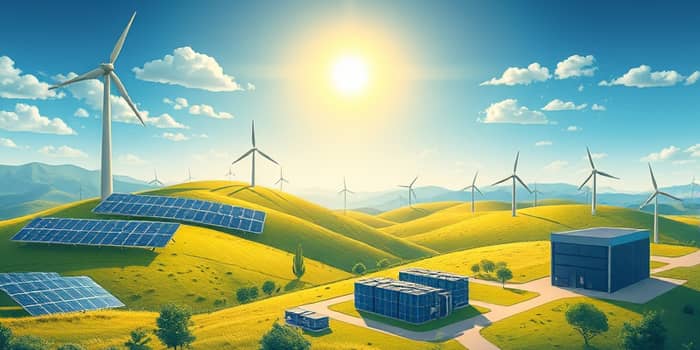
From the rolling fields of solar panels to the silent hum of wind turbines, the renewable energy sector has matured into a cornerstone of modern investing. Once a niche passion project, clean energy now commands trillions in global capital and offers compelling returns. As 2026 unfolds, investors have an unprecedented opportunity to balance risk, seize growth, and align portfolios with a sustainable future.
In this article, we explore record investments, evolving market trends, policy shifts, and strategic pathways to help you power up your portfolio with renewables.
The Rise of Renewable Investment
In 2025, global clean energy investment surged to over 2.3 trillion dollars, more than double traditional energy spending. Renewables alone accounted for an estimated 780 billion, outpacing oil by 245 billion. Solar projects attracted 450 billion in capital, while battery storage investments soared to 66 billion. These numbers reflect the sector’s newfound maturity and growing appeal among institutional and private investors.
Historical returns further reinforce this momentum. Over the past decade, renewable assets have delivered an average 15.7 percent annual return, consistently outperforming fossil fuel counterparts. More than ninety percent of new renewable projects now undercut the cost of coal and gas alternatives, driving stronger adoption rates across emerging and developed markets alike.
- Global clean energy investment: 2.3 trillion in 2025
- Solar sector funding: 450 billion
- Battery storage growth: 66 billion
- Average annual returns: 15.7 percent over ten years
2026 Market Trends and Capacity Additions
The year ahead brings its own set of dynamics. Analysts predict the first annual solar slowdown in decades, as China scales back installations from 300 gigawatts in 2025 to around 200 gigawatts in response to competitive bidding policies. Yet, cumulative global photovoltaic capacity is slated to double in the next five years, underscoring sustained long-term growth.
Meanwhile, rapid scaling for data centers is driving a surge in battery energy storage systems. Onshore wind capacity is projected to rise 45 percent by 2030, reaching 732 gigawatts, while offshore wind may face modest declines due to high costs and permitting hurdles. Firms are increasingly pairing solar with storage to deliver reliable power and unlock new revenue streams.
Key Market Drivers
Behind these headline figures lie powerful demand drivers. Hyperscale tech companies now account for more than 90 percent of US-based clean energy contracts, procuring nearly 27 gigawatts for data centers, warehousing, and operations. long term PPAs with inflation links offer stability in volatile markets. Meanwhile, global electrification efforts from transportation to industry are modernizing grids and accelerating renewables adoption.
Policy and Regulatory Shifts
Policy remains a critical catalyst. In the United States, safe-harbor provisions are fast-tracking 2026 deployments, and foreign entities of concern rules limit technology sourcing from strategic adversaries. Tax credits for renewable and storage projects extend through 2030, offering investors enhanced yield potential.
China has already achieved its 2030 wind and solar targets six years ahead of schedule, doubling clean energy investments to 625 billion in 2024. Globally, streamlined permitting and hybrid PPA structures are emerging, combining solar, wind, and storage to maximize utilization and profitability.
Top Companies and Investment Vehicles
Leading the charge are industry bellwethers with proven track records. NextEra Energy’s North America expansion is supported by a robust balance sheet and long-dated PPAs, while EDP Renováveis in Europe and Adani Green Energy in South Asia are scaling rapidly across renewables and storage.
- NextEra Energy: diversified utility-scale portfolios
- EDP Renováveis: European wind & solar leader
- Adani Green Energy: emerging market powerhouse
Risks and Challenges
No investment is without risk. Supply chain disruptions and tariff adjustments threaten component availability, while grid bottlenecks and curtailment can impact revenue streams. Permitting delays continue to hamper offshore wind projects, and macroeconomic volatility calls for disciplined capital allocation.
Investors should also monitor policy shifts closely; sudden changes in tax incentives or eligibility criteria can alter project economics overnight. A careful balance of geography, technology, and counterparty strength will help mitigate downside exposure.
Opportunities and Strategies
Despite challenges, the opportunity set remains vast. Accelerating solar plus storage hybrids for hyperscalers delivers both reliability and premium pricing. Emerging digital tools—AI-driven demand forecasting and predictive maintenance—enhance asset performance and drive returns.
Consider a diversified approach:
- Combine utility-scale solar, onshore wind, and battery storage
- Pursue corporate PPAs for revenue visibility
- Target emerging markets in Southeast Asia and Africa
Looking Ahead
As the 2026 horizon comes into focus, five overarching trends stand out: hyperscaler demand growth, storage innovation, supply chain resilience, policy efficiency, and deployment acceleration. Hybrid PPAs and flexible procurement models will continue to evolve, offering new pathways to decarbonize portfolios.
Ultimately, renewable energy is not just a sector choice but a commitment to long-term value creation and global impact. By deploying capital across technologies and regions, investors can harness long-term infrastructure build-out while contributing to a cleaner, more resilient energy future.
Powering up your portfolio with renewables is both a strategic imperative and a moral responsibility. Embrace the energy transition today and join the movement that will define tomorrow’s prosperity.
References
- https://www.deloitte.com/us/en/insights/industry/renewable-energy/renewable-energy-industry-outlook.html
- https://energytracker.asia/renewable-energy-investment-opportunities/
- https://www.ecohz.com/blog/five-renewable-energy-trends-into-2026
- https://energyconferencenetwork.com/navigating-the-future-key-investment-trends-in-renewable-energy-for-2026/
- https://rmi.org/the-energy-transition-in-2026-10-trends-to-watch/
- https://www.spglobal.com/energy/en/news-research/special-reports/energy-transition/horizons-top-cleantech-trends-2026
- https://press.spglobal.com/2025-12-09-S-P-Global-Energy-Releases-Key-Clean-Energy-Trends-for-2026-as-AI-Growth-and-Geopolitical-Shifts-Reshape-Global-Energy-Markets
- https://about.bnef.com/insights/finance/energy-transition-investment-trends/
- https://www.astracanyon.com/blog/renewable-energy-trends-to-watch-in-2025
- https://www.lseg.com/en/ftse-russell/research/2026-sustainable-investment-trends
- https://acarasolutions.com/blog/recruiting-trends/renewable-energy-industry-outlook-for-2024/
- https://www.utilitydive.com/news/utility-electricity-trends-outlook-2026/810990/
- https://energy-infrastructure-partners.com/five-trends-shaping-energy-infrastructure-in-2026/