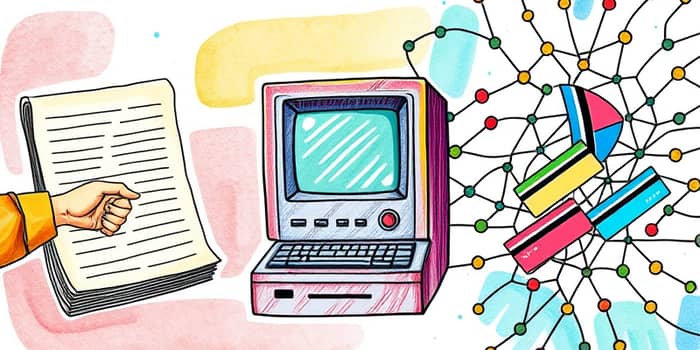
Credit scoring is more than a number. It represents decades of innovation, regulation, and stories of trust transformed by technology. From small-town bankers assessing reputations by word of mouth to sophisticated machine learning engines processing millions of data points in real time, the journey has been profound. This article explores how the industry shifted from human judgment to data-driven predictions, and why understanding this history can empower consumers, lenders, and policymakers alike.
A Journey from Trust to Standardization
Before the 1950s, lending decisions rested on relationships and local reputation. A merchant knew his community; he could look a borrower in the eye and judge character. In tight-knit towns, this system worked, but as populations became mobile, it revealed its limits. Disparate assessments were deeply subjective and inconsistent, leaving many deserving borrowers without access to credit simply because they lacked local connections.
In 1841, the Mercantile Agency attempted to introduce the first standardized evaluation, but it still relied heavily on human opinion. Only in the mid-20th century did two visionaries, Bill Fair and Earl Isaac, coalesce statistical insights into a repeatable process. Their founding of Fair, Isaac and Company in 1956 marked the birth of objective statistical modeling to support decisions, creating the first credit scoring system in 1958. Lenders began to glimpse the promise of algorithms over anecdotes.
The Rise of Algorithmic Scoring
As credit bureaus like Equifax and TransUnion expanded through the 1960s and 1970s, they laid the groundwork for computerized decision-making. Limited memory on early computers meant only basic variables—number of accounts, balances, payment histories—were used. Nevertheless, this shift prepared the industry for the next big leap.
- 1958: Fair, Isaac and Company deployed its initial scoring model.
- 1970: The Fair Credit Reporting Act enshrined consumer rights in credit reporting.
- 1989: FICO introduced the first universal score, applicable across industries.
With the FICO universal score, lenders finally had a consistent algorithm to credit report data that predicted repayment risk. Adoption was gradual; banks needed education to trust machine outputs over gut instinct. Yet once Fannie Mae and Freddie Mac mandated FICO scores in 1995, the balance quickly tipped. Manual reviews gave way to faster, more uniform decisions.
Comparing Pioneering Credit Models
These milestones illustrate how models evolved in response to data availability, regulatory changes, and competitive pressures. The universal score democratized lending decisions, while joint ventures like VantageScore challenged incumbents and promoted more inclusive practices.
Innovation in the Modern Era
In the early 2000s, rising computing power unlocked sophisticated statistical techniques such as logistic regression and decision trees. Financial institutions hired data scientists to mine hundreds of variables related to payment patterns, credit utilization, and account age. Scorecards moved from batch processing to real-time decision-making, integrating data feeds that could approve or deny loans in seconds.
Credit decision engines became integral to bank technology stacks. Companies like Capital One pioneered profitability scoring, evaluating not just default risk but also lifetime value, marketing response, and churn potential. This broader perspective on customer behavior reshaped lending, making credit segments more nuanced and dynamic.
Meanwhile, regulation continued to shape practices. The Equal Credit Opportunity Act outlawed discrimination based on protected characteristics, forcing models to be fairer. The Internal Ratings-Based Approach (IRBA) under Basel regulations demanded that banks demonstrate model robustness, accuracy, and governance. As scrutiny grew, model developers adopted comprehensive validation processes and documentation standards.
Current and Emerging Trends
- Machine learning and AI integration for deeper pattern recognition.
- Use of nontraditional credit information and metrics like rental payments and utility records.
- Emphasis on ensuring algorithms are unbiased, with audits for fairness and transparency.
- FinTech platforms leveraging open banking and alternative data to democratize credit access.
Traditional FICO and VantageScore systems still dominate, covering over 90% of lending decisions. Yet a vibrant ecosystem of startups and banks is experimenting with voice data, psychometric assessments, and social signals to augment risk profiles. Behavioral economics insights are woven into these models to gauge borrower habits and decision-making tendencies more accurately.
What Lies Ahead
The future of credit scoring hinges on balancing innovation, privacy, and fairness. As real-time data streams—from digital wallets to IoT devices—become available, models can adapt within days or hours, not months. But this speed raises questions about consumer surveillance and privacy concerns. Policymakers, regulators, and industry leaders must collaborate to set ethical guardrails that protect individuals while enabling innovation.
For consumers, understanding the forces shaping their credit scores is empowering. Regularly reviewing reports, addressing errors, and managing diverse credit accounts can improve one’s profile. Lenders, meanwhile, can harness advanced analytics responsibly to expand credit access and manage risk more effectively.
The evolution of credit scoring is a testament to human ingenuity—transforming subjective judgments into mathematical frameworks that fuel global commerce. Yet at its heart lies a social contract: responsible access to credit can uplift communities and drive economic growth. By embracing transparent, equitable models, we can write the next chapter in this ongoing story, one where data-driven decisions serve everyone with fairness, speed, and compassion.
References
- https://www.creditsesame.com/blog/credit-score/from-trust-to-tech-the-evolution-of-credit-scoring/
- https://taktile.com/articles/from-credit-scoring-to-genai
- https://www.marketplace.org/episode/the-history-of-credit-score-algorithms-and-how-they-became-the-lender-standard
- https://www.chase.com/personal/credit-cards/education/credit-score/history-of-credit-scores
- https://www.visualcapitalist.com/history-consumer-credit-one-infographic/
- https://www.koho.ca/learn/origin-of-credit-scores/
- https://vantagescore.com/resources/knowledge-center/vantagescore-innovation-history-timeline-1st-to-market-list
- https://www.experian.com/blogs/ask-experian/the-history-of-credit-cards/
- https://www.turnkey-lender.com/blog/the-evolution-of-the-credit-scoring-system-in-modern-lending/
- https://www.gecreditunion.org/learn/education/resources/money-minutes/march-2022/national-credit-education-month-the-history-of-credit-scores