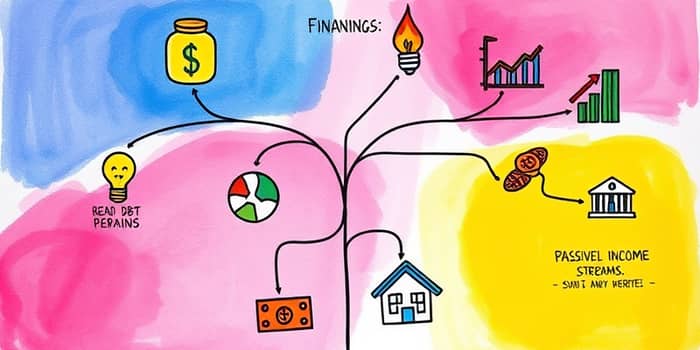
Embarking on the path to financial freedom can feel overwhelming without a clear roadmap. A structured sequence of decisions helps you focus on what matters most at each stage of your journey. By visualizing choices as a flowchart, you can move from budgeting basics to generating significant passive income with clarity and purpose.
This article presents a step-by-step guide that combines proven metrics, strategic actions, and real-life examples. You will learn how to set targets, eliminate debt, automate wealth-building, and ultimately achieve independence. Let’s begin.
Set Your Financial Freedom Number (Assessment Phase)
The first step is defining a specific target. Calculate how much passive income you need to cover living expenses, often between $10,000 and $20,000 per month. Then break it down into yearly milestones: Year 1: $1,000/month; Year 2: $2,000; Year 3: $5,000; Year 4+: $10,000–$20,000.
Next, take a comprehensive inventory. Use online tools to track income, expenses, debts, and savings accurately. Record current balances, interest rates, and monthly cash flows. With this data, run projections using retirement calculators to visualize your path to a $50,000 annual spending goal or beyond.
Establish SMART goals—Specific, Measurable, Achievable, Relevant, Time-bound—for short-term and long-term achievements. For instance, aim to pay off high-interest credit cards within six months and accumulate a three-month emergency fund by year-end.
Budget and Cover Essentials
A solid budget is the foundation of every flowchart. Divide your income into three categories: needs, wants, and savings/investments. Allocate funds for rent or mortgage, utilities, groceries, and minimum debt payments under “needs.” Under “savings,” direct at least 15% of income toward retirement and emergency reserves.
To free up extra cash, scrutinize recurring subscriptions and discretionary spending. Redirect any savings automatically to your high-yield accounts. This automate savings and investments strategy ensures steady progress without requiring constant vigilance.
Build Emergency Fund and Eliminate Debt
Once your budget is in place, the flowchart asks: “Do you have high-interest debt?” If yes, eliminate high-interest debt first. Focus on credit cards, personal loans, or any balances charging over 10% interest. Make minimum payments on all other balances while allocating extra cash to the highest-rate accounts.
After clearing expensive debt, redirect those payments toward an emergency fund. Aim for 3–6 months of expenses stored in a high-yield savings account. This buffer protects you from unexpected events and prevents new debt accumulation.
Maximize Tax-Advantaged Savings
With debt behind you and a cash cushion secured, it’s time to leverage employer-sponsored plans. The flowchart’s next decision point: “Are you receiving the full employer match?” If not, contribute enough to max employer 401(k) match immediately. This is free money you cannot afford to leave on the table.
Once matched, increase your retirement contributions to at least 15% of pre-tax income. Consider opening an IRA or HSA if eligible. Diversifying account types gives you flexibility to access funds before traditional retirement age if needed.
Advanced Wealth-Building and Diversification
After securing basic retirement savings, explore additional investment vehicles. Low-cost index funds and ETFs offer broad market exposure with minimal fees. Adjust your asset allocation based on your time horizon: conservative allocations for goals under five years, more equity weight for longer-term objectives.
If you have children, evaluate 529 plans or other college savings vehicles. Allocate initial lump sums and set up recurring contributions. Align the plan’s aggressiveness with your child’s age and investment horizon.
Generate Passive Income and Scale
When you consistently save at least 15% and maintain your emergency fund, the flowchart branches into generating and scaling passive streams. Real estate often becomes a central pillar. Using a proven blueprint, you can build a rental portfolio systematically:
- 1. Set your freedom number.
- 2. Choose a cashflow strategy (rentals, REITs).
- 3. Define a buy box with clear criteria.
- 4. Build a lead funnel for property sourcing.
- 5. Develop a capital deployment plan.
- 6. Select a financing approach.
- 7. Track weekly KPIs for deal flow.
- 8. Establish accountability partnerships.
- 9. Use a CRM to manage leads.
- 10. Underwrite deals regularly.
- 11. Implement a renovation playbook.
- 12. Set up property management processes.
Beyond real estate, diversify into dividend-paying stocks, peer-to-peer lending, or digital assets. The key is maintaining momentum and reinvesting returns to accelerate growth.
Key Metrics for Success
Tools and Resources
- Mint, YNAB, EveryDollar for budgeting.
- Debt Payoff Calculator for repayment planning.
- Vanguard, Betterment, Wealthfront for investing.
- Roofstock for rental property acquisition.
- T. Rowe Price and NerdWallet retirement calculators.
By following this structured comprehensive financial freedom flowchart guide, you move confidently from basic budgeting to true independence. Each decision point refines your focus, ensuring that every dollar works toward your ultimate goal.
Remember that consistency and adaptability are your greatest allies. Track your progress monthly, celebrate milestones, and adjust the flowchart as life circumstances evolve. With patience and discipline, you will transform your financial landscape and unlock the freedom you deserve.
References
- https://www.youtube.com/watch?v=lGrK8nuJL2Q
- https://www.youtube.com/watch?v=MUmq5az67UU
- https://goklaim.com/post/financial-independence-a-roadmap-to-financial-freedom
- https://www.troweprice.com/personal-investing/resources/insights/6-steps-to-achieve-financial-independence-and-retire-early.html
- https://moneyguy.com/guide/foo/
- https://financialmechanic.com/the-ultimate-flowchart/