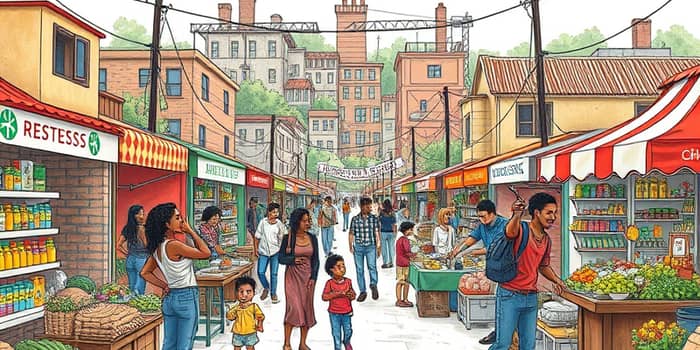
Across continents and generations, we’ve poured resources, expertise, and hope into fighting poverty, yet billions remain trapped in cycles of scarcity. What if the solution lies not in more aid but in reimagining innovation itself? This idea is the core of market-creating innovation, a concept that transforms how we think about wealth, opportunity, and human potential.
The Failure of Traditional Aid Models
For decades, governments and NGOs have relied on grand interventions: delivering food, funding infrastructure, and prescribing top-down policies. Despite noble intentions, many efforts have led to minimal gains—sometimes even backsliding. At least twenty nations that received billions in aid are now poorer than before, a counterintuitive finding that challenges the very premise of conventional development.
- Trial and error methodology without local context
- Top-down efforts imposed from afar
- Flooding regions with resources in hopes of change
- Focus on symptoms rather than systemic roots
Each of these approaches treats poverty as a problem to be fixed, rather than an opportunity to be liberated through innovation. When recipients become dependent on external funding, true agency and sustainable growth remain elusive.
Unveiling Market-Creating Innovation
Instead of amplifying existing markets or improving products for the wealthy, market-creating innovation shifts attention to areas of nonconsumption—places where people simply cannot access or afford a product or service. By redesigning complex, high-cost offerings into affordable solutions, entrepreneurs unlock enormous latent demand.
This transformation generates a virtuous cycle:
- Demand surges as affordability expands.
- Companies hire more workers to meet production needs.
- Distribution networks and retail outlets multiply.
- New services and training programs emerge.
- Jobs and household incomes rise.
- Tax revenues grow, funding public goods.
In essence, each affordable product becomes a catalyst for net growth for corporations and communities alike, fueling a self-reinforcing ecosystem of prosperity.
This table illustrates how a single innovation can ripple through an economy, strengthening both private enterprise and public welfare.
Lessons from Historical Pioneers
The roots of modern prosperity often trace back to entrepreneurs who saw nonconsumption where others saw only risk. Their successes demonstrate that less initial capital can yield more lasting wealth when guided by creative problem-solving.
- Singer Sewing Machines: Reduced sewing time by 75%, making garment production accessible.
- Ford Model T: Transformed automobiles from luxury to everyday transport.
- Mo Ibrahim’s Telecom: Brought affordable mobile service to millions in Africa.
In the mid-1800s, Singer’s machines cut production time from eight hours to two. Families gained income, mechanics required training, and retail outlets sprouted to serve a burgeoning market. Later, Henry Ford adopted similar principles: his Model T democratized travel, spurring road construction, fueling oil industries, and creating countless jobs.
On another continent, Mo Ibrahim’s bold venture defied skeptics who doubted Africans’ ability to pay for mobile service. Within seven years, his network reached over five million subscribers, generated substantial tax revenues, and became a blueprint for telecommunications across developing markets.
The Principle of Nonconsumption
At the heart of market-creating innovation lies the discovery of nonconsumption: unmet needs hidden in plain sight. When innovators shrink costs and simplify complexity, they unlock markets that never existed. This is not charity—it is commerce with a conscience, aligning profit motives with social impact.
Nonconsumption markets share key traits:
- Minimal competition due to affordability barriers.
- High initial risk but vast untapped potential.
- Community-driven adoption once entry hurdles fall.
By focusing on nonconsumers, enterprises can achieve systemic economic growth that uplifts entire regions, rather than incremental improvements for a select few.
Looking Ahead: Sustainable Prosperity
Forecasts suggest that by 2050, extreme poverty may be a relic of the past if market-creating innovations spread globally. However, these projections hinge on widespread adoption of the right strategies—a challenge in itself.
Key actions for tomorrow’s leaders include:
- Encouraging policies that support entrepreneurial risk-taking.
- Investing in infrastructure that amplifies distribution.
- Fostering skills training aligned with emerging industries.
- Promoting local partnerships over imported solutions.
By weaving these elements into national development plans and corporate strategies, societies can transition from cycles of dependency to engines of innovation. This journey demands courage to embrace uncertainty, humility to learn from local contexts, and a commitment to seeing potential where scarcity once prevailed.
The true measure of wealth arises not from the size of a budget or the volume of aid, but from the ability to convert obstacles into opportunities. In this light, the Prosperity Paradox offers more than a theory—it provides a roadmap for transforming scarcity into abundance, one innovation at a time.
References
- https://www.harpercollins.com/products/the-prosperity-paradox-clayton-m-christensenefosa-ojomokaren-dillon
- https://faithdriveninvestor.org/episode-33-efosa-ojomo/
- https://academic.oup.com/book/8821/chapter/155005438
- https://knowledge.wharton.upenn.edu/article/prosperity-paradox-clayton-christensen/
- https://kk.org/thetechnium/radical-optimis/
- https://www.becomingminimalist.com/the-prosperity-paradox/
- https://www.christenseninstitute.org/blog/shifting-the-conversation-from-poverty-alleviation-to-prosperity-creation/
- https://www.christenseninstitute.org/blog/what-is-the-prosperity-paradox-a-refresher-on-the-key-to-ending-poverty/
- https://www.insidehighered.com/blogs/technology-and-learning/catching-our-nonfiction
- https://community.cadence.com/cadence_blogs_8/b/breakfast-bytes/posts/clayton
- https://www.cgdev.org/event/accelerating-innovation-climate-and-pandemic-preparedness
- https://www.youtube.com/watch?v=gz_5Jo_XHJI
- https://www.innosight.com/insight/the-prosperity-paradox/