As the world’s population soars and climate challenges mount, innovators are turning to revolutionary methods of food production. Vertical farming offers a beacon of hope, combining science, technology, and sustainability under one roof. This article dives into the essence of this transformative approach, exploring practical steps, inspiring success stories, and the promise of a greener future.
What Is Vertical Farming?
At its core, vertical farming grows crops in stacked layers within controlled indoor environments, such as warehouses, repurposed buildings, or even shipping containers. By employing soilless methods like hydroponics, aeroponics, or aquaponics, farmers can precisely deliver nutrients and water without relying on traditional fields.
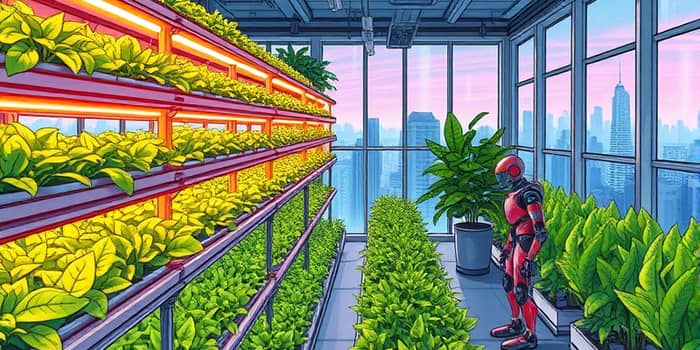
Through a synergy of sensors, robotics, and cutting-edge LED lighting arrays, environmental variables—light, temperature, humidity—are optimized. This year-round sustainable crop production model bypasses weather risks, soil depletion, and geographic constraints, enabling fresh local produce in any urban setting.
Core Benefits Transforming Our Future
Vertical farming addresses urgent global challenges by maximizing resource efficiency and reducing environmental impact. Its advantages extend far beyond novelty, providing measurable gains for producers, consumers, and the planet.
- Up to 99% less land required compared to horizontal fields.
- Closed-loop water recycling systems that cut usage by 95%.
- 10x higher crop yield per square meter through multi-tiered setups.
- Pesticide-free produce grown in pristine, sealed chambers.
- Local harvests slashing food miles and carbon emissions.
These breakthroughs create pathways to food security in rapidly urbanizing regions and conserve valuable ecosystems by freeing farmland for reforestation.
Technologies Powering Vertical Growth
Behind every thriving vertical farm lies an arsenal of sophisticated tools. LED lights tuned to photosynthetic wavelengths mimic sunlight, while real-time environmental monitoring ensures optimal growth conditions.
Automation plays a starring role: robotic arms plant seeds, deliver nutrients, and harvest greens with precision. Data analytics predict yield fluctuations, allowing operators to plan distribution with unrivaled accuracy.
Integration with renewable energy sources further reduces operating costs and lowers the carbon footprint. Many farms now pair solar panels or wind turbines with on-site battery storage, creating virtually carbon-neutral food hubs.
Real-World Inspirations
Across the globe, vertical farms are sprouting in unexpected places, demonstrating both versatility and scalability. In London, historic tunnels repurposed beneath the city produce fresh herbs delivered within hours of harvest. In Singapore, sky-high towers teem with lettuce and basil, feeding urban residents without a single pesticide.
- AeroFarms in New Jersey achieves market-leading yields of salad greens through aeroponic mists.
- Freight Farms’ modular containers travel easily, enabling startup farms in rural communities.
- Growing Underground in England uses former air-raid shelters to cultivate microgreens year-round.
These pioneers prove that both high-tech startups and community cooperatives can harness vertical farming’s potential.
Overcoming Challenges
No innovation arrives without hurdles. Vertical farms demand significant upfront capital for LED arrays, climate systems, and automation equipment. Electricity consumption can be steep, and many operations rely on grid power.
Crop variety remains limited: fast-growing lettuces and herbs dominate because grains and fruits often require more space and time. Achieving profitability at scale demands careful crop selection, efficient design, and often, supplemental revenue streams such as agritourism or workshop hosting.
How to Get Started
- Research local regulations and available grants for controlled-environment agriculture.
- Start small: pilot a desktop or shipping-container unit to refine techniques.
- Choose fast-cycling, high-value crops like leafy greens or culinary herbs.
- Invest in reliable sensors and AI-driven environmental control networks.
- Explore renewable energy options to reduce operational expenses.
- Partner with local restaurants or farmers’ markets to secure distribution channels.
By scaling at a measured pace, prospective growers can balance learning curves with financial sustainability.
The Future of Food Security
With global food demand projected to rise by 56% by 2050, vertical farming stands at the forefront of agricultural innovation. It offers resilience against climate-induced crop failures, pandemic disruptions, and supply chain volatility. Urban populations can reclaim sovereignty over their food supply, forging community ties through rooftop gardens and neighborhood greenhouses.
As technology advances, we can expect expansion into fruits, medicinal plants, and even staple grains. Ongoing research aims to further cut energy needs, diversify crop portfolios, and streamline automation.
Conclusion: Cultivating Hope
Vertical farming represents more than a novel cultivation technique—it embodies a vision of sustainable coexistence with our environment. By harnessing innovative controlled-environment agriculture and localizing food systems, we can nourish communities, preserve natural landscapes, and inspire future generations to grow smarter, greener, and together.
References
- https://www.interesjournals.org/articles/vertical-farming-revolutionizing-agriculture-in-the-modern-era-111272.html
- https://www.wastex.io/post/what-is-vertical-farming
- https://www.freightfarms.com/blog/vertical-farming
- https://www.nidwater.com/how-vertical-farming-will-change-agriculture
- https://brae.calpoly.edu/braevertfarm
- https://en.wikipedia.org/wiki/Vertical_farming
- https://modernagriculture.ca/technology/the-key-to-vertical-farming/
- https://extension.unr.edu/publication.aspx?PubID=7157